
Time Study 02: Ancestral Time
Notes from downstream

This is the second of my Time Study series, which you can read more about here.
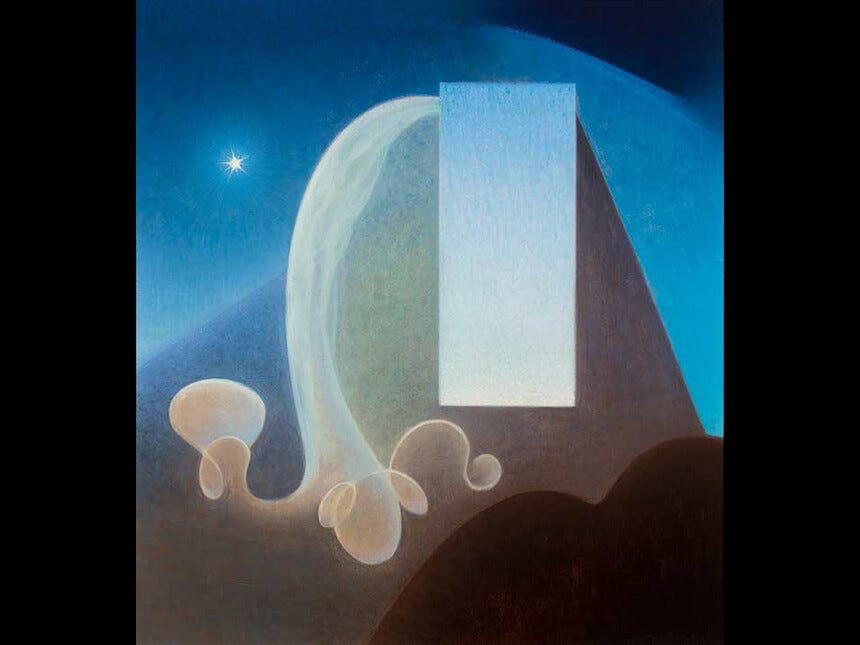
Where are your ancestors?
If you conceive of time as a linear arrow, moving from left to right on a horizontal axis, then you might say that your ancestors are somewhere behind you, marked by a fixed, nondescript point. The more you walk, the further they recede. Their voices seem to fade even as they speak. They, too, have once theoretically wielded the torch of time, but now that it’s you who must carry the stick of light forward, they seem to reside in a glassy black box. You’re already a million paces ahead. When you squint, you can somewhat make them out, stick figures on a clay wall.
Let’s consider a different configuration.
In the Chinese language, the direct translation of “last month” is 上个月, or “upper month.” Similarly, “next month” translates to 下个月, or “lower month.” Here, time flows vertically, like a river wriggling down a mountain. In this paradigm, your ancestors would be somewhere above you, a great weight on your shoulders. You cannot escape them, because you must carry them. When they accidentally spill their oolong tea, it drops on your head. The ooze you feel dripping down the back of your neck is the joke their hen laid. To be precise, it’s your great-great-great-great ancestor’s hen, clucking you off for not offering her food.
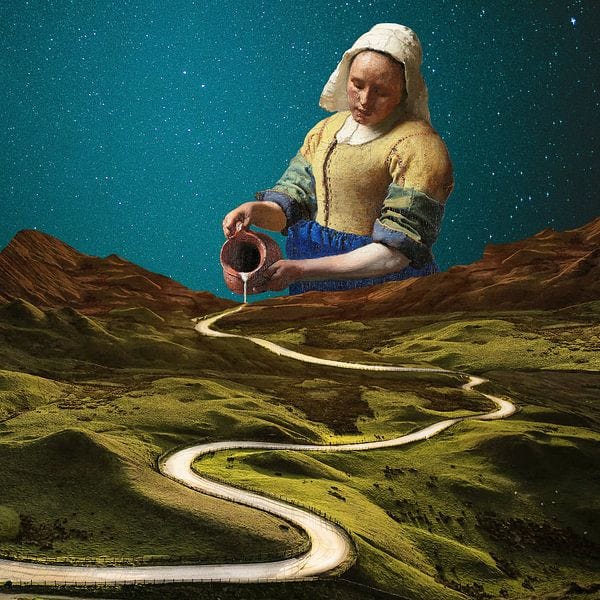
Are your ancestors still out there?
Did you know that time moves faster on a mountain than it does at sea level? And that time is slower when you’re actively moving, especially when you’re moving really really fast? Turns out, time is not an objective container within which we live; it’s a property of matter that varies based on context.
“Times are legion: a different one for every point in space. There is not one single time; there is a vast multitude of them.” –Carlo Rovelli
Einstein explains this with a drawing of a criss-crossed blanket, the four-dimensional fabric of spacetime. In the middle is our earth making a big fat dent. Its gravity warps spacetime around it, pulls time down with it. Everything slows down the deeper you go. This is why you find the eternally young by the ocean, and the wizened monks on a mount- you literally age slower at sea.
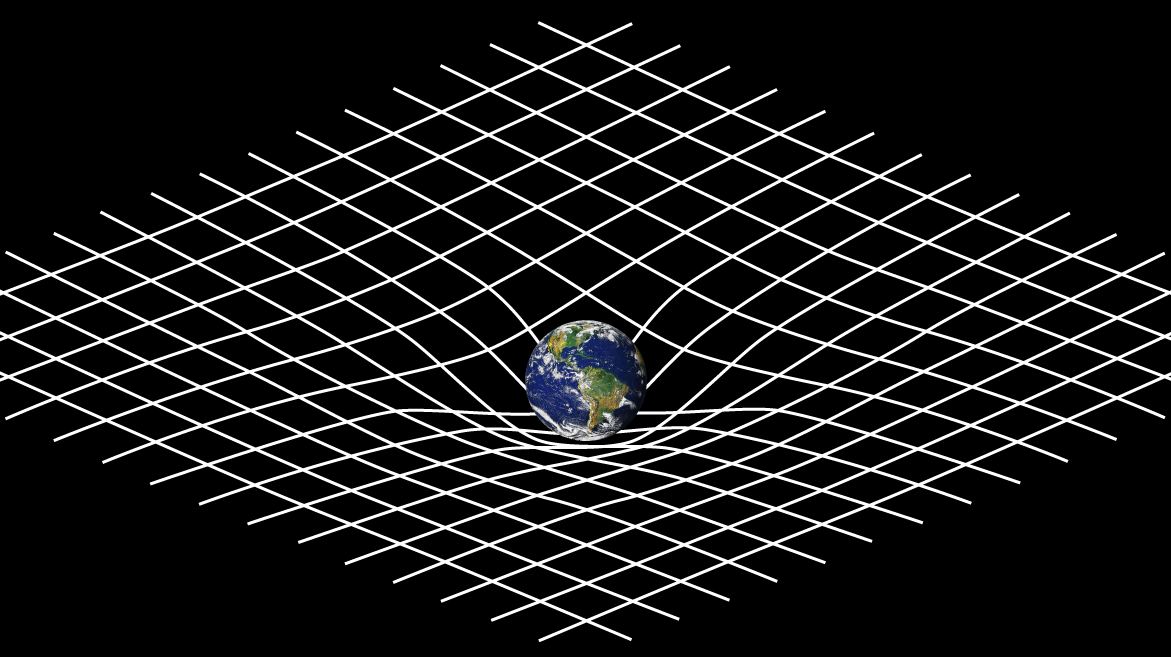
I’m not sure what this means for our ancestors in the paradigm of top-down time, where they are somewhere above us, freed from the constraints of gravity. They could be aging at the speed of light. Which would place them… ahead of us?!
-===≡≡≡┌( ͝° ͜ʖ͡°)┘
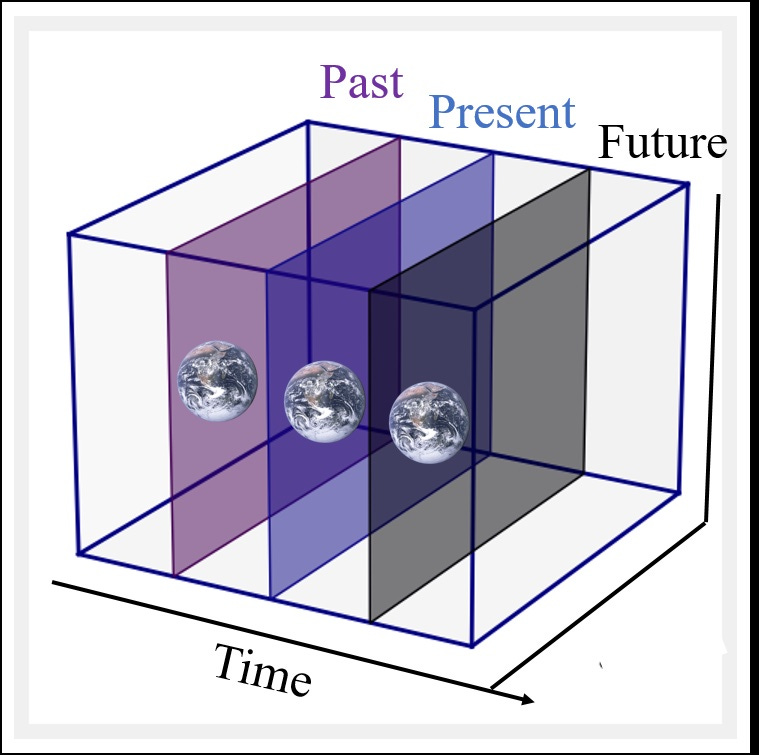
But of course, at the speed of light, time stops altogether, which is less like aging and more like eternity… so let’s just call it eternity. This brings me to another shape of time that physicists propose, which is a loaf of bread, with our present just a jammy slice in the middle. The past and the future exist as eternal and simultaneous slices, which would mean that the past still exists, and the future has been determined. Welcome to the Block Universe Theory. (I won’t try to get into the physics but it’s surprisingly well supported by general relativity, though quantum physics throws a wrench in it).
Aboriginal peoples are probably rolling their eyes, thinking it’s about time we figured this out. Their concept of the Everywhen (as coined by W.E.H. Stanner- it is also referred to as The Dreaming) offers a similar framework, where Ancestral Beings do not “die” and disappear, but instead go into the earth and become rocks, waterholes, stars. Ancestors are not memories, but are present, lived realities. Tyson Yunkaporta writes in Sand Talk:
Creation time isn’t a long long ago event, because creation is still unfolding now, and will continue to unfold, if we know how to know it. It all comes out from that central point of impact, that Big Bang expanding and contracting, breathing out and in, no start or finish, but a constant state where past, present, and future are all one thing, one time, one place. Every breath ever taken is still in the air to breathe. I breathe the breaths of the ancestors, and everybody else’s too. Always was, always is, always will be. And there are flowers here, and they make me smile.
Sometimes I’ll look at a memory of myself, maybe riding the train across the Tuscany landscape while nursing an espresso in a tiny disposable cup, or resting my head on my backpack while bouncing across a potholed road in a tuktuk, and I’ll feel this eerie sensation that she’s still out there, still riding that train or tuktuk. It suddenly seems counterintuitive that she ever stopped, that she didn’t stay inside her toasty slice of “now.” Maybe she’s still out there. Maybe my ancestors are, too.
Reaching out across the loaf of time…
Can I reach backward (or forward) and poke at their pillowy time? I think about this while idly scanning a map of Taipei, wondering where my great-uncle could’ve walked. This is when I feel a jolt of recognition upon noticing a place called Hakka Cultural Park. “Wait… aren’t I Hakkanese?” I say out loud.
My question was answered when I (finally) went about transcribing an interview that I recorded with my dad last summer. One of the first things he mentions is that his family is Hakkanese, a sub-ethnic group who migrated from Northern to Southern China. Hakkanese translates to 客家人 (kèjiā rén), or literally “guest people.” There’s something familiar about this idea, of taking permanent residence in the identity of a guest (maybe it’s our destiny to keep nomading after all…).
It was striking how much I had already forgotten about the conversation. Ancestry is slippery when there’s no modern-day relevance; you can lose it across generations, or within a few short months. In the interview, my dad tells stories that are easy to marvel at intellectually but difficult to understand viscerally. He condenses all the drama into a few spare sentences, like “your great grandparents committed suicide by drinking rat poison together, because they could not bear the torture and humiliation of the Cultural Revolution.” Or “my dad was in prison for 8 years, and my mom could’ve given up on him and chosen another suitor (she had many), but she didn’t, choosing instead to check the bulletin everyday to see if he had been killed.”
My reaction is one of wow, I come from a badass legacy. But if I’m honest, the stories feel more like polished stones I can put on display in my cabinet of curiosities— something I can feel proud of for saying that I own, but not anything I know what to do with. It’s like I’m fetishizing my ancestry, showing off something I have no real relationship with.
Meeting ancestors in the verbs
One way I’ve been trying to reconnect with ancestry is by re-learning Chinese, the first language I spoke before it was eaten by English. I’ve had a nagging curiosity about whether there are parts of me that have gotten buried under imported words and concepts. Julie Sedivy writes in Memory Speaks, “Losing your native tongue severs you not only from your own early life but from the context of your life… your sense of who you are has blank spaces in it.” What could I unearth by re-discovering my ancestors’ language?
For example, verbs unlock an alternate psychology in Chinese, as they are often interchangeable with nouns. This is partly because verbs aren’t conjugated. Instead, time is marked through context or particle words, while the verb continues on in a “temporal openness.” It doesn’t fade into the past tense just because it’s finished.
What does it do to your wiring if your verbs just keep going, refusing to be placed on a timeline? Francois Jullien, a French philosopher who studies the distinction between Eastern and Western thought, says that Chinese/Daoist thought looks at reality as “fundamentally processual, not thing-like.” Where Greek philosophy asks “What is it?”, classical Chinese thought would ask “How does it flow?” Old/young, love/indifference, past/present- these aren’t static poles; they’re just always becoming each other.
Is it even necessary to invent time then? The Chinese language doesn’t quite have an equivalent. Rather than “time” being a container within which we fret and stress, time is the ongoing process of transformation itself. (Fun fact: the Chinese word for time, 时间, roughly translates to “between moments,” and uses the same character as ma from my last essay!) Physicist Carlo Rovelli verifies this notion that our world is fundamentally made of events, not things (this is actually what general relativity implies, if you follow the math):
The world is not a collection of things, it is a collection of events. the difference between things and events is that things persist in time; events have a limited duration. A stone is a prototypical “thing:” we can ask ourselves where it will be tomorrow. Conversely, a kiss is an “event.” It makes no sense to ask where the kiss will be tomorrow. The world is made up of networks of kisses, not of stones.
...On closer inspection, in fact even the things that are most “thinglike” are nothing more than long events. The hardest stone... is in reality a complex vibration of quantum fields, a momentary interaction of forces, a process that for a brief moment manages to keep its shape, to hold itself in equilibrium before disintegrating again into dust, a brief chapter in the history of interactions between the elements of the planet...
So maybe when I talk about ancestral time, what I’m really saying is that we are still experiencing the active transformation of our ancestors, even after they’ve passed on. Their character and actions are still vibrating, evolving into their consequences. And we are downstream, surfing the ripples from their lives.
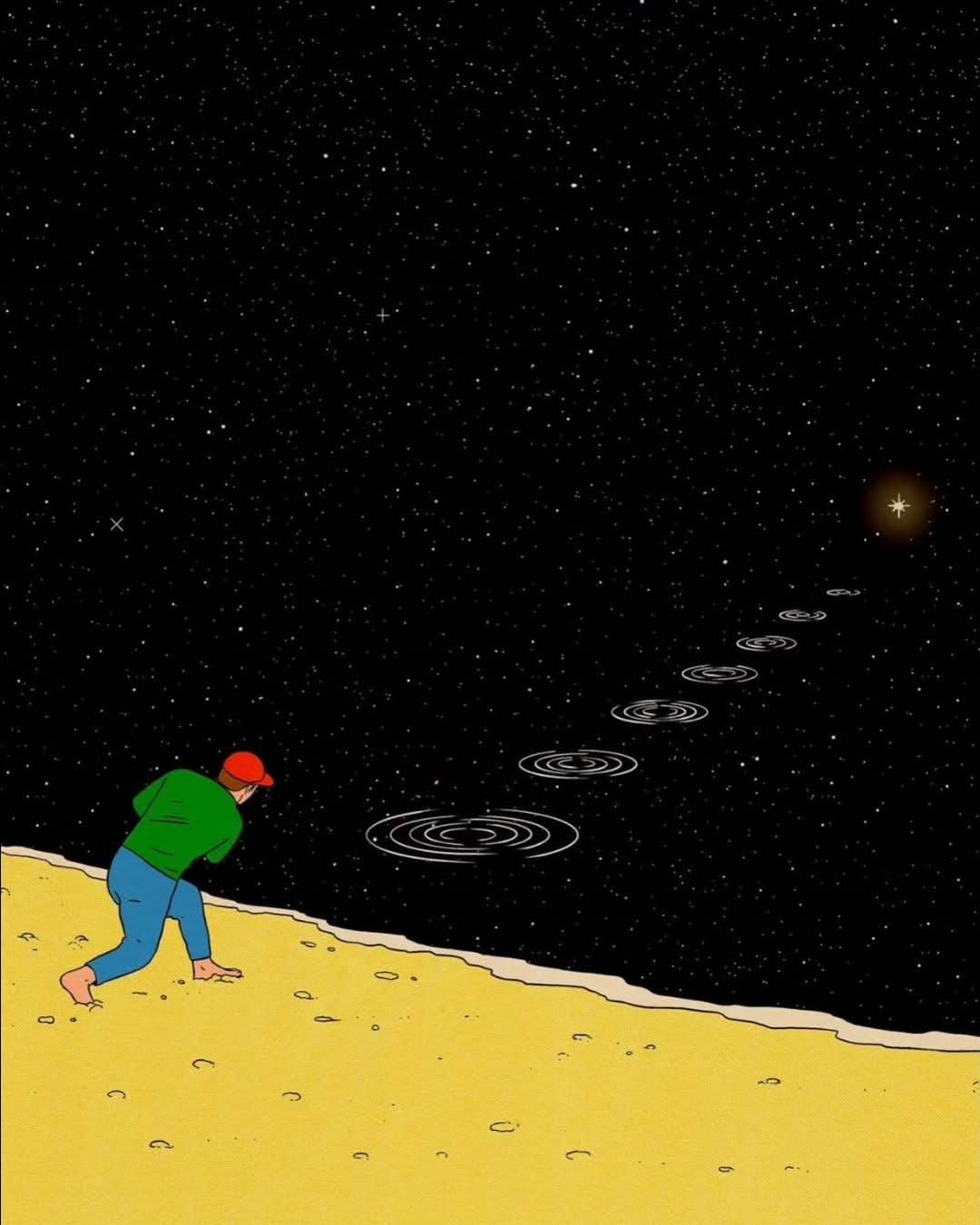
Testing, 1 2 3… Hi grandma?
It was high time I said hello to my ancestors. I decided to pick a relative each day and spend some time with them, imagining what it could’ve felt like to live in their bones.
My grandma was ready to meet me. When I lit the incense and whispered a hello, she arrived immediately, as if she had been waiting for me to crack open the door. I was flooded with her tears, as I watched her scan the bulletin for news of her imprisoned husband, then take the long way back as she held her tiny, silent hope. I thought about the enormous stone in her stomach after discovering her parents dead (and later, her son), and I wept.
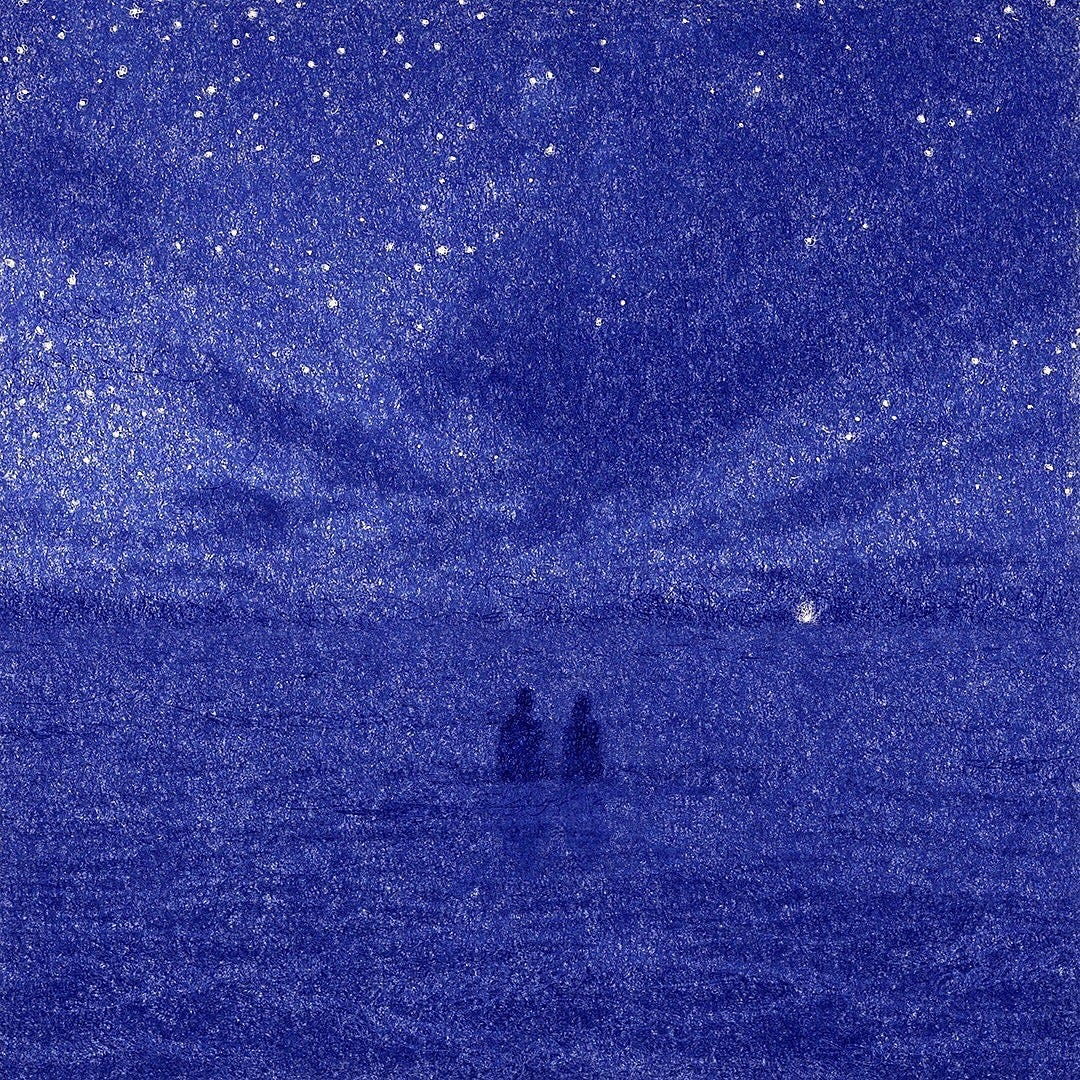
My dad says that he hasn’t cried since he was a child, and I have a feeling this was true for my grandma as well. Because of her suffering, she hardened herself into a block of ice. Was it the same for my great grandparents? Have tears been accumulating over generations, pressing on the walls of their bodies, stuck behind their mouths and eyes?
What if my life, my brilliantly mundane life, was the first time these tears could find a way out? Finally, a life with no real resistance or suffering, just a wide open backyard with a swingset and pool. Maybe that’s why I seem to be a perpetually leaky faucet, with water spilling out of my eyes at all inopportune times (e.g. during a yearbook staff interview when asked what my hobbies are, or while trying to provide feedback to the president of my company, or during every objectively bad romcom…)
Maybe I’m the opening where a lake becomes a river, the threshold where still water begins to flow. How many generations of tears will I cry during my lifetime? Will they flow back into the earth, return to soil and roots? Will a mangrove tree grow there, provide shade for my kids? My grandma’s decision to wait for her husband is a tree whose shade I still rest under. I am the ripple effect of her loyalty, endurance, and love.
I pour my grandma some tea. My grandma. I can feel her sitting beside me even as I write this, stoic and silent, as she waits for my Chinese to bubble up again. She is amazed at my existence, the miracle of my mundanity. I realize now that my normal, suburban American upbringing is not “random,” not even “lucky,” and certainly not something to scorn. It is the fruit of my ancestors’ labor, their secret hopes. Even when I’m sobbing in the corner of a McDonald’s parking lot while dramatizing the passage of time- even then am I still living their dreams.


Ancestral time is not about memory or loss, but about ongoing transformation. It is an overlapping of time, a folding of the past into the present. My ancestors walk in front, behind, above, below me; they properly surround me. I can feel them nudging me on, opening up my path. And as they journey through the darkness ahead, I shall try, and try again, to not lose sight of their light.
With love from the ancestors,
Jessie
Grateful for the following resources, most of which I am still learning from:
A Wild New Work’s podcast episode, titled Ancestors: The Cloud of Support Around You
The Order of Time by Carlo Rovelli
Memory Speaks: On Losing and Reclaiming Language and Self by Julie Sedivy
Sand Talk by Tyson Yunkaporta
Tao Te Ching by Laozi, translated by Ursula K. Le Guin
Poetics of Relation by Édouard Glissant
A Treatise on Efficacy & The Silent Transformations by François Jullien
Ooo wee this piece has so many layers! depths! dimensions!! I love how this massaged my brain to think about the ways time bends, how language can shape our understanding of time and that ancestral time is ongoing and living through us. Reminds me of something I learned about the Hopi native people and how they don't have past/present/future language. They refer to things as either "manifested" as whats passed or "unmanifested" for potential. What an interesting read. Loving this time studies project!